I worked on improving the translation efficiency of circular RNA, with a focus on IRES and UTR elements. The broader research objective is to contribute to a circular RNA-based vaccine platform that combines the durability of circRNA with improved protein expression.
RESEARCH EXPERIENCE · 2026
Chung-Ang University.
Undergraduate research in RNA engineering and circRNA translation optimization at Kim Hakyun Lab, Chung-Ang University.
Research Focus
Key Projects
PROJECT 01 · SZ1 IRES
Structural analysis of translation-enhancing mutations
I investigated why a single-nucleotide substitution in SZ1 IRES produced relatively high translation. By comparing predicted RNA secondary structures, I focused on a mutation that caused a distinctive local structural change near the end of a loop region.
This observation led me to consider whether changes in RNA structure or interactions with RNA-binding proteins could contribute to the translation phenotype. I proposed follow-up experiments to the professor and graduate researchers and carried out additional mutation and rescue experiments.
PROJECT 02 · IRES / UTR SCREENING
Systematic screening for high-efficiency combinations
I participated in a large-scale screening workflow involving approximately 90 IRES candidates. Higher-performing IRES candidates were selected for subsequent UTR testing, with approximately 50 UTR candidates evaluated in 5′, 3′, and combined configurations.
The screening was used to identify combinations associated with higher translation efficiency. Among the tested designs, EVB80 and FMDV IRES candidates showed promising activity, and selected 3′ UTR configurations produced substantially higher translation signals than the FHB reference.
Experimental Approach
Construct design → PCR / cloning → plasmid preparation → transfection → luciferase assay → quantitative comparison → candidate selection
- Molecular cloning including KLD and In-Fusion approaches
- Primer redesign and vector-compatible overhang design for In-Fusion cloning
- HEK293T cell culture and transient transfection
- Dual-luciferase evaluation of translation efficiency
- IRES mutation, structural comparison, and rescue experiments
Troubleshooting
Changing the experimental strategy
During IVT and circularization experiments, RNA bands were frequently degraded or difficult to visualize by PAGE. I considered RNA stability and circularization yield as possible causes and changed the strategy toward a Tornado-based DNA-level approach, allowing transcription and circularization to occur in mammalian cells.
I also compared the conventional KLD cloning workflow with In-Fusion cloning. This required adapting primer design and incorporating vector-compatible overhangs. These changes made the workflow more practical and produced more stable experimental results.
What I Learned
These experiments taught me to treat unexpected results as questions rather than simply as failed experiments. In particular, the SZ1 IRES work gave me experience connecting an observed phenotype to RNA structure, forming a hypothesis, proposing a follow-up experiment, and testing that hypothesis experimentally.
Selected Data
Structural analysis · SZ1 IRES
Computational structure analysis was added as a complementary step to explore whether the SZ1-2C mutation could be associated with a change in predicted RNA structure.
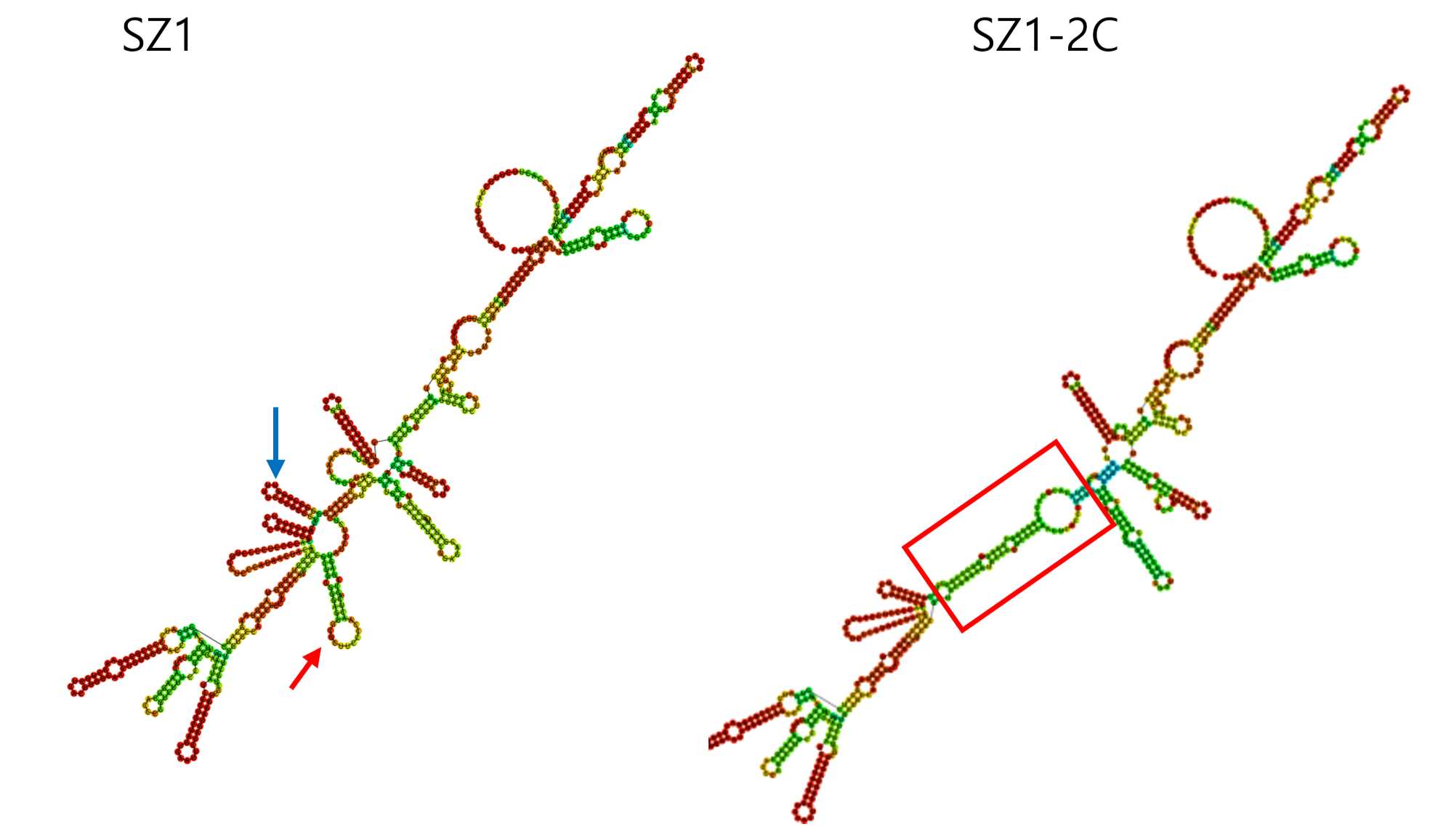
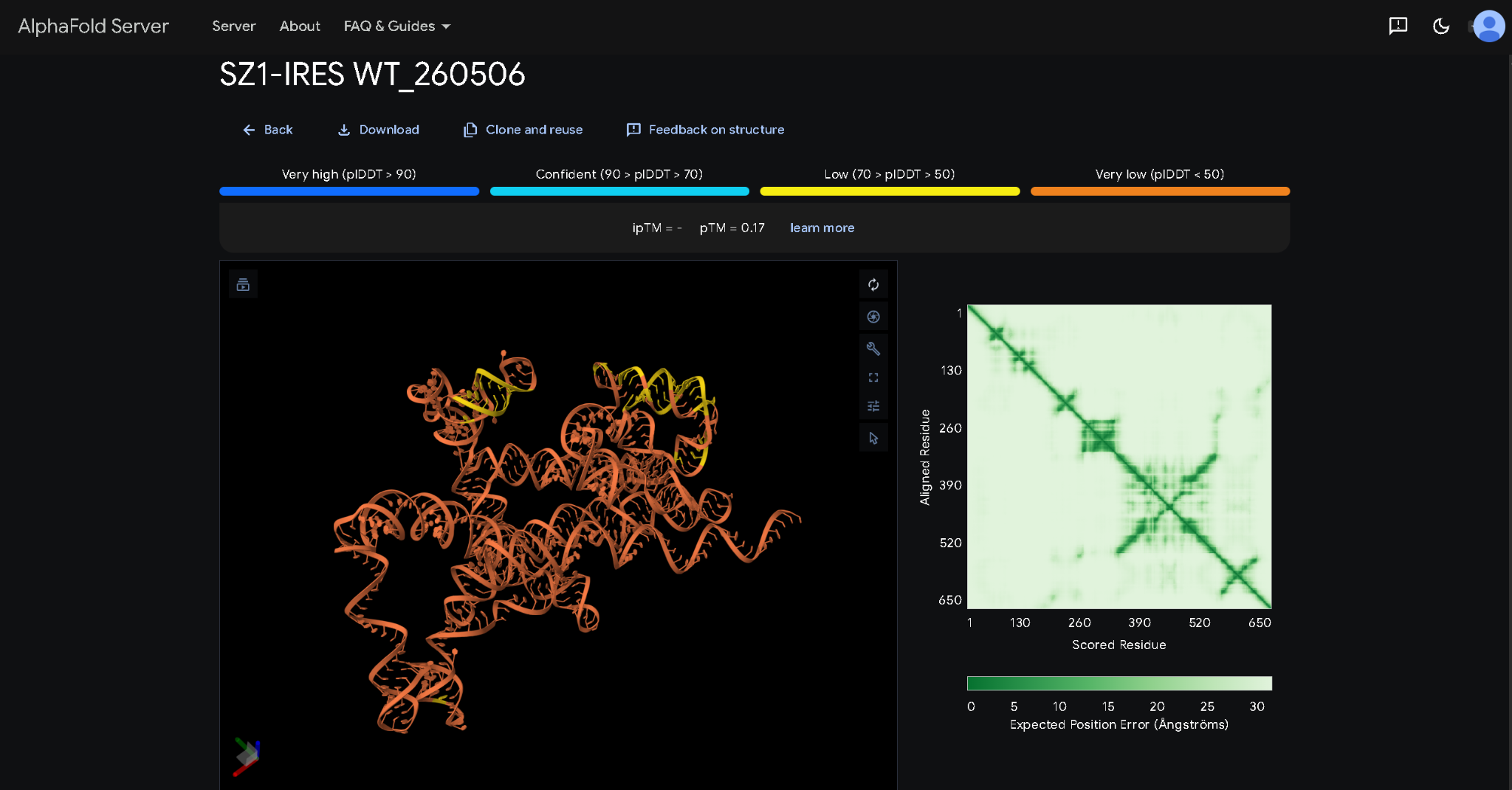
RNAfold prediction was used as a complementary structural analysis step to compare the SZ1-2C sequence with WT. The computational observation was used to formulate a structural hypothesis that was then explored through mutation and rescue experiments.
IRES screening
Representative candidates from two screening repeats. Translation efficiency is normalized to the FHB IRES reference (=100). Error bars are represented by the between-repeat spread for this compact portfolio view.
The full screening dataset contains 103 IRES candidates across the grouped screens; 12 candidates were identified at ≥3× the FHB reference in the summarized screening result, followed by selection of 5 candidates for UTR screening.
UTR screening
UTR position was tested independently at the 5′ and 3′ ends, followed by combined 5′+3′ configurations. In the combined dataset, 5A3A denotes ACAT at both ends and 5H3H denotes HBA1 at both ends.
5′ UTR only · repeat 2
3′ UTR only · repeat 2
5′+3′ UTR · 2026-08-27 dataset
Across the tested constructs, UTR position clearly affected translation: several 5′-only additions were lower than the FHB reference, while selected 3′-only and combined ACAT configurations remained comparatively high. The combined dataset contains all 16 recorded constructs, including the FHB reference.
SZ1 IRES mutation
YJ replicate set, normalized to WT SZ1 (=100). SZ1-2C was the notable single-substitution candidate retained for structural interpretation and rescue testing.
In a separate rescue comparison, SZ1-2C remained elevated relative to WT in both JW (113.4) and YJ (117.3) replicate sets, supporting follow-up interpretation rather than a single isolated measurement.